
Early Learning at the Library: Silliness is Serious Business

“What happens in storytime, stays in storytime.”
Seeing this motto on a library poster, children’s librarians like me can feel free to be as silly as we want – to read with funny voices or wear crazy hats and goofy socks. You may be thinking what really happens in that little room or in the many classes for 0-5 year olds offered at HCLS branches? Well, I’d like to open the door on the educational experiences that little ones and their caregivers experience at the library – what happens while you’re in the room and how instructors prepare beforehand.
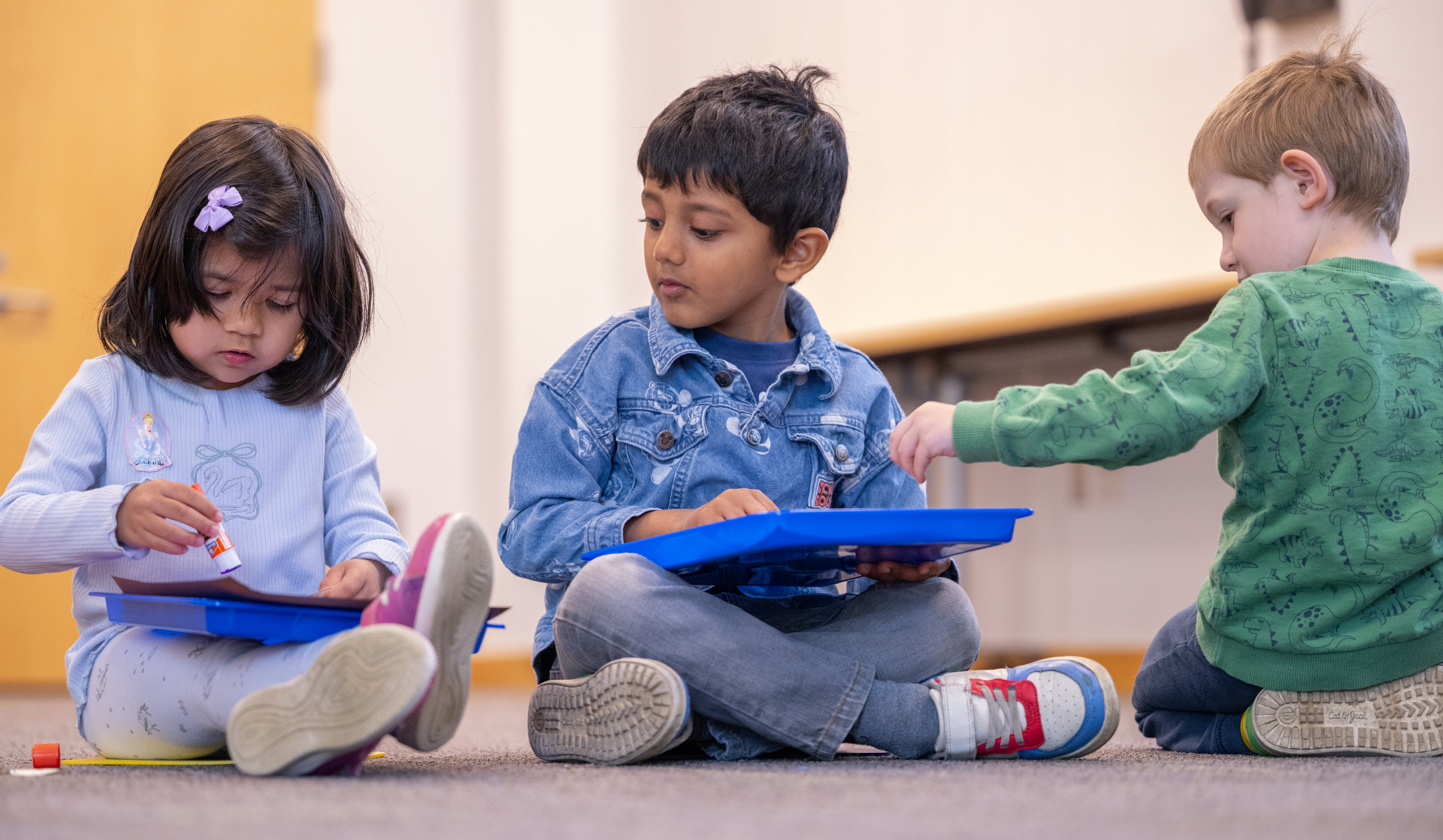
Whether you attend a Play Partners session with an infant or a Little Learners class for preschoolers, participants can count on plenty of lively activity. Of course, there will be books – interactive read-alouds that engage little ones with stories and pictures. You might also hum along with nursery rhymes and songs that are easy to remember and repeat at home. Music-making and movement allows children and their caregivers to ring gentle bells, wave colorful scarves, jump with an egg shaker, or swim like a fish! There may even be time to play with toys or have small art and science experiences like finger-painting and water play. You might even find an instructor with a squiggly squid hat, a giant giraffe puppet, or a rippling rainstick. It’s guaranteed to be fun!
And yet, we’re not offering children’s classes just for the fun of it. Beneath the stories, singing, and silliness, you find layers of substantive preparation and connection with child development goals. Children learn primarily through play – even with the most ridiculous rhymes and songs. To support these essential development goals and build kindergarten readiness, HCLS Children’s Instructors rely on the Maryland Early Learning Standards (MELS) in designing their plans. These standards provide a guideline for developmentally appropriate experiences for each age group and across various learning domains. Every class plan for 0-5 year olds incorporates activities and materials that align with the MELS, highlighting the educational impact of each experience.
Building language and literacy takes top priority in our planning. For example, instructors carefully choose appealing, diverse, and interactive books to share, and incorporate valuable practices like pointing at pictures, introducing new words, and demonstrating letter sounds. Story-based classes support school readiness in many other ways beyond the books:
- Social-emotional skills grow when we practice naming our feelings, notice facial expressions in books, and build community with others in the class.
- Physical and motor skills improve when we do a freeze dance (impulse control!) or complete a craft using scissors.
- Early cognition and STEAM skills expand when we use a flannel board game for sorting, predicting, or counting, and when we engage in creative arts.
- Problem-solving skills develop as we practice following directions, talk about how a book character dealt with a problem, or find different ways to use a toy.
Who knew so much brain boosting could happen in a 30-minute class with a chicken theme? Share the joy and the learning by finding a class at HCLS that’s right for you and your little ones. They occur on a regular schedule at all six branches; check our website, hclibrary.org/children for details.
Jean is a Children’s Instructor and Research Specialist at HCLS Central Branch. She loves talking about books with people of all ages, but especially enjoys leading the Heavy Medals book club for fourth and fifth graders, exploring award-winning books of all genres.
Related Articles
Banned Books Week: Let Books Be
Bauder Book Talk Creative Arts Competition
Getting Around Your Community
Stay connected with our newsletters.
Newsletter Subscriptions